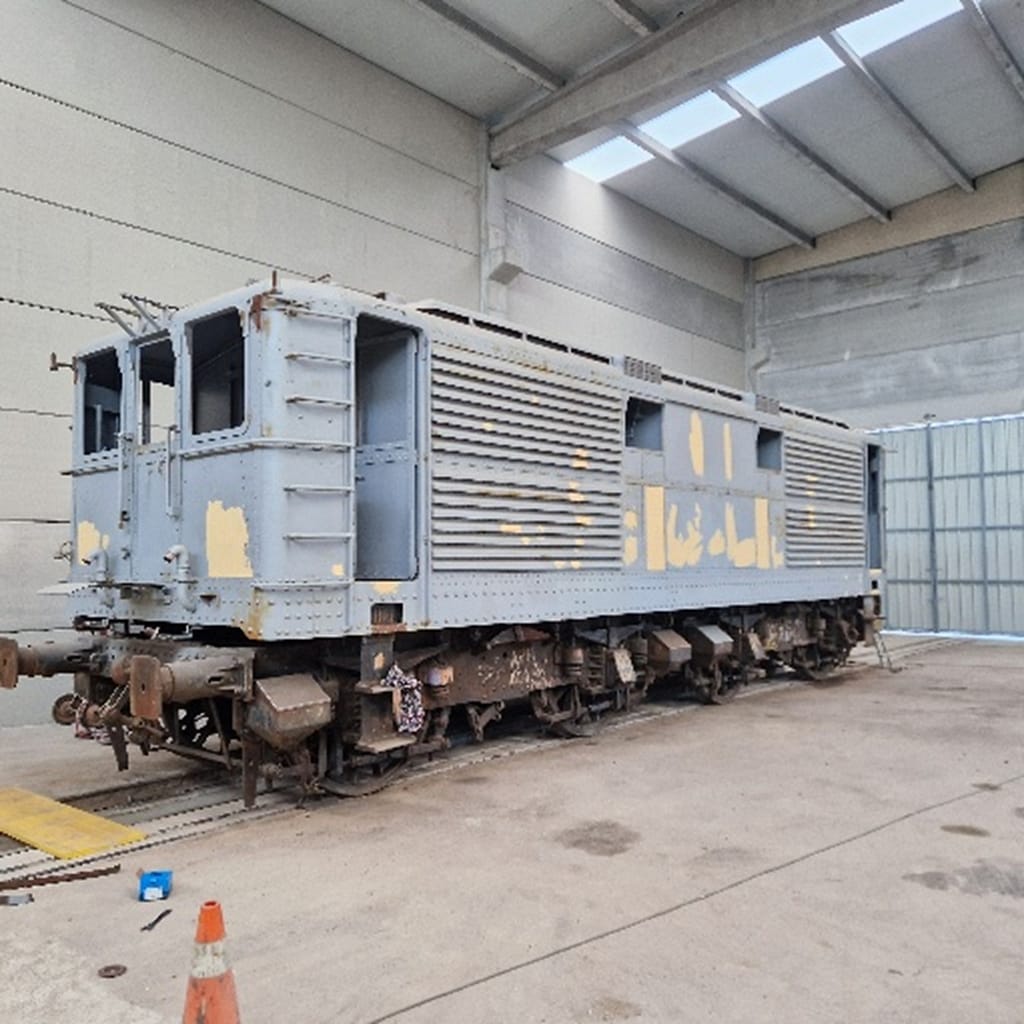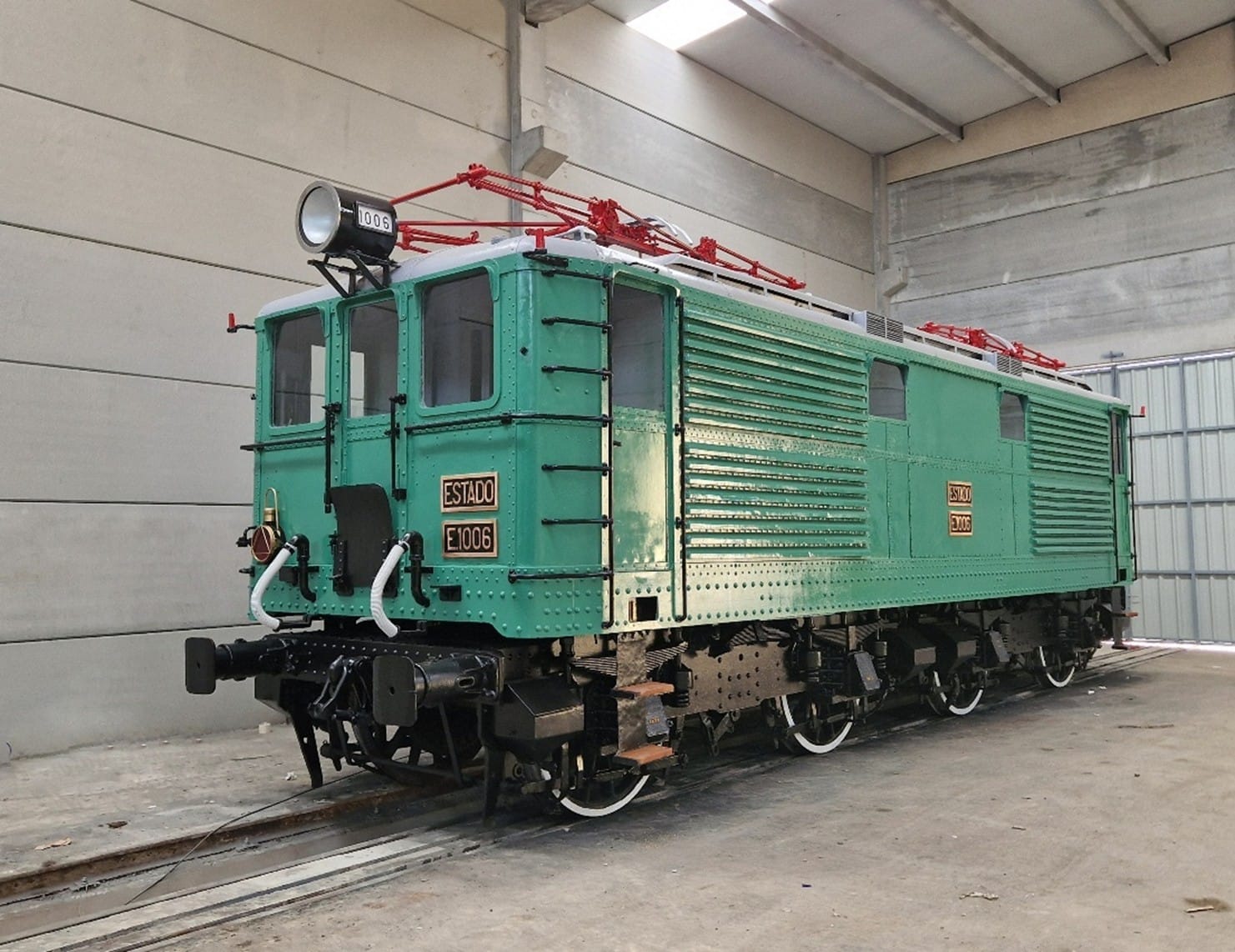
These seven State locomotives were intended for the Ripoll-Puigcerdà-La Tour-de-Carol Trans-Pyrenean Railway line, to offer a mixed passenger and freight service. They were built in 1927 by C.A.F. (Compañía Auxiliar de Ferrocarriles), receiving electrical equipment from C.E.F. (Constructions Électriques de France) of Tarbes. The machines were very similar to the E-4001 to E-4040 of the Midi de France company. Initially, the machines received a gray-green color because at that time, the main base of the paint was lead white, a lead pigment that made exterior paint more resistant.
At the beginning of 1964, the voltage transformation from 1,500 to 3,000 volts for locomotives began at the MACOSA factory (Sociedad Material y Construcciones S.A.) in Valencia, and by the Swiss company Ateliers de Secheron for the electrical components. With the voltage change, pantographs were replaced, multiple control was abandoned, they were equipped with an electromagnetic extra-fast circuit breaker, the traction motors were adapted to 3,000 volts, and the minimum and maximum relays were changed.
Locomotive 1006 departed for its conversion in November 1965 and returned to Ripoll in October 1966, after trials were carried out between Tarragona and Móra la Nova, hauling a coal train. For this, a driver and an assistant from the Ripoll depot traveled.
They were always on the Ripoll to Puigcerdà line, and sometimes they traveled to the Barcelona-Vilanova workshop for some repairs. The last regular service of the Omnibus Correo No. 1901/1902 between Ripoll and Puigcerdà was carried out by locomotive 1006 on September 25, 1982, when the Correo was discontinued. From that day on, they only made sporadic services with work trains, some freight, and if it snowed, they went out to explore the tracks. Their end was hastened in 1987 with the inauguration of the Cerdanya Pullman service, as locomotives from series 279, 289, and 269 were authorized to run on the line. In February 1993, RENFE ceded locomotive 1006 to the Ripoll City Council. Locomotive 1002 was destined for scrapping, but it was in good condition, completely intact and with all four traction motors, so they decided to swap their plates. Thus, the original 1002, which actually carries the numbering of the 1006, was displayed on the pedestal at the Ripoll station. The other locomotive, missing most of its components, was set aside, and RENFE sold it to a scrap dealer. The dealer decided not to dismantle it because that intervention would have cost more than abandoning it on a dead-end track.
Finally, in 2022, the Sant Joan de les Abadesses City Council commissioned the aesthetic rehabilitation to the Móra la Nova Museum.
Technical data sheet
| Any construction | 1927 |
| Constructor | CAF |
| Track width | 1.668 mm. |
| Length | 11.912 mm. |
| Height | 3.770 mm. |
| Amplification | 2,950 mm. |
| Pes | 74.8 terameters. |
| Axis layout | Bo' Bo' |
| Tension | 1.500 Vcc (through the 1964 model year) 3.000 Vcc |
| Motors | 4 x DECA 80 |
| Power | 736 kW |
| Maximum speed | 65 km/h |
Client: Sant Joan de les Abadesses City Council
Types of Restoration: Cosmetic
Any: 2024