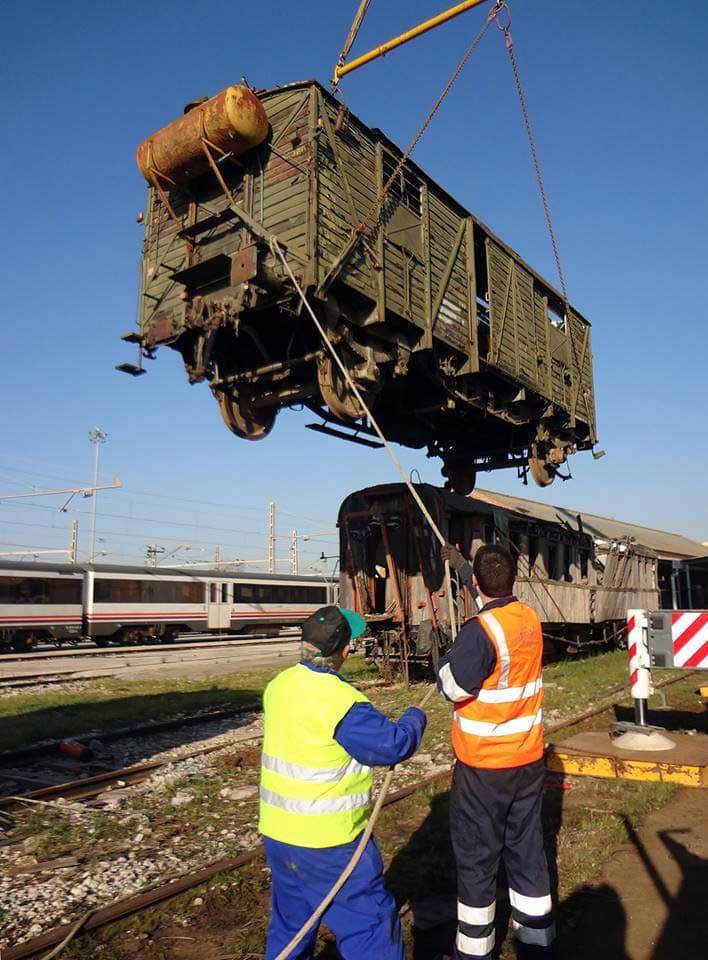
The precedent for this type of vehicle was the boiler van of the Norte company, which in winter supplied heating to passenger train compositions with a system powered by the steam produced by the locomotives, but when traction was provided by an electric locomotive, the vans carried a vertical Field-type boiler, with coal and water tanks that supplied it, hence the name boiler vans.
Beginning in 1952, with the expansion of electric traction lines, sixty-four unified cars from the Jfvi 300020 series were converted into the Jfv 306501 series of 1961, keeping the same number, but replacing the J with DT or DTV, depending on whether or not they had a small luggage compartment. Inside, a steam boiler was installed that produced low-pressure steam heating, which was fueled by diesel. There were also a couple of tanks for fuel and water. An employee, with the classification of heaterman, was responsible for feeding and maintaining the appropriate pressure. Many of these personnel were firemen from steam locomotives.
In February 2017, the boiler van VTfv.306.260 arrived at the Móra la Nova Museum, on loan from the Spanish Railways Foundation. Subsequently, this piece, which was so common in passenger trains of the past, underwent aesthetic restoration, and we can now enjoy watching it move along the museum's tracks.
Technical data sheet
| Any construction | 1951 to 1961 |
| Constructor | CAF – MMyC - MACOSA |
| Series | Jfvi 300020 - Jfv 306501 |
| Company | RENFE |
| Track width (mm) | 1.668 |
| Axis layout | 2 Axes |
| Length (mm) | 9.950 |
| Height (mm) | 3.706 |
| Width (mm) | 2.930 |
| Loaded weight (kg) | 18.170 |
Client: FPPFI
Restoration Types: Functional
Any: 2018